


.png "Durable Lightweight Spinner Luggage")




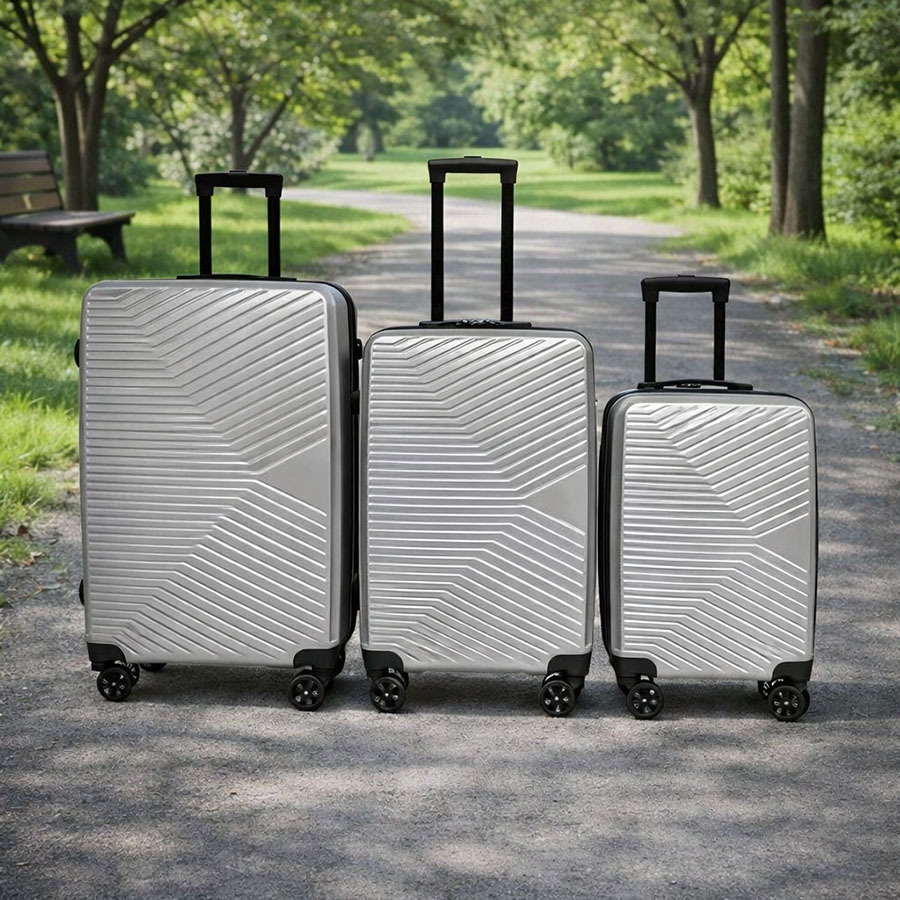
12 Common OEM Luggage Sampling Mistakes to Avoid Before Mass Production
A mistake on one luggage sample is usually inexpensive to correct.
The same mistake repeated across 500, 1,000, or several thousand suitcases can become a much more expensive problem.
That is why sampling should not be treated simply as the stage where a buyer checks whether a suitcase “looks good.”
For luggage brands, importers, wholesalers, distributors, retailers, and private-label buyers, sampling is where product expectations should be converted into an agreed manufacturing reference before mass production begins.
Material, components, dimensions, colors, branding, functionality, workmanship, packaging, and quality expectations all need to become increasingly clear during this stage.
When working with an OEM hard shell luggage manufacturer China, the objective of sampling should therefore be simple:
identify uncertainty while it is still inexpensive to change.
Here are 12 common OEM luggage sampling mistakes—and how professional buyers can reduce the risks behind them.
1. Starting a Sample Before the Specification Is Clear
One of the most common mistakes is asking a factory to “make a sample first” while major specifications are still undecided.
Even a relatively simple suitcase may involve decisions about:
shell material;
shell thickness or target weight;
surface finish;
color;
wheels;
trolley system;
carry handles;
zipper specification;
lock;
interior lining;
divider and pockets;
expansion;
logo application;
accessories;
packaging; and
size combination.
If these details are unclear, the factory must either stop and ask more questions or make assumptions.
The resulting sample may be technically acceptable but still different from what the buyer imagined.
A better approach is to define the most important requirements before the first customized sample begins.
The specification does not need to be perfect at this stage, but critical commercial and functional requirements should already be clear.
A basic sampling specification can include:
| Item | What to Confirm |
|---|---|
| Target Market | Country, channel and customer type |
| Product Positioning | Promotional, mid-range, premium, etc. |
| Sizes | Carry-on, medium, checked or set combination |
| Shell | Material, finish, color and weight target |
| Wheels | Type, appearance and performance requirement |
| Trolley | Construction, height and finish |
| Zipper/Lock | Required type and configuration |
| Interior | Lining, divider, pockets and straps |
| Branding | Logo method and position |
| Packaging | Bag, carton, labels, barcode and inserts |
| Commercial Target | Approximate FOB range and order quantity |
A clear specification reduces unnecessary sample revisions for both buyer and factory.
2. Treating a Factory's Existing Sample as the Finished OEM Product
Existing factory models are extremely useful.
They allow buyers to evaluate shell shape, dimensions, construction, basic components, packing capacity, and overall appearance without developing everything from zero.
But an existing model is usually better treated as a product platform, not automatically as the finished private-label product.
When working with a custom luggage manufacturer, buyers should separate two questions:
Which parts of this model already work for our market?
and
Which details need to change to support our brand positioning?
Potential customization may include:
shell colors;
matte, glossy or textured finishes;
wheels;
trolley and handle details;
zipper pullers;
locks;
interior lining;
logo treatment;
accessories;
packaging; and
size combinations.
Customization should have a reason.
Changing a component simply because it can be changed may add complexity and cost without adding meaningful consumer value.
The strongest OEM projects customize the details that support product positioning while retaining proven elements where customization is unnecessary.
3. Approving Appearance Without Testing Function
Luggage is not a static product.
It contains wheels, trolley tubes, handles, zippers, locks, hinges, dividers, pockets and other components that travelers repeatedly operate.
A sample can therefore look excellent in photographs while still containing functional weaknesses.
During sample evaluation, buyers should actively use the product.
Extend and retract the trolley repeatedly.
Roll the suitcase forward, backward and sideways.
Open and close the main zipper.
Operate the lock.
Lift the suitcase from each carry handle.
Check the divider, straps, pockets and lining.
If the model includes expansion, open and pack the expanded section.
For a zipper luggage factory, zipper quality should not be judged only by appearance. Buyers should also check movement through corners, alignment, stitching, zipper-puller operation and how the zipper system interacts with the shell.
A good sample approval process evaluates both:
how the luggage looks and how the luggage works.
4. Evaluating Luggage Only While It Is Empty
This is one of the easiest sampling mistakes to make.
An empty suitcase can feel very different from the same suitcase under realistic travel weight.
Loading creates additional force around:
wheel housings;
wheel mounting areas;
trolley connections;
carry handles;
shell corners;
zipper sections;
expansion areas; and
internal mounting points.
A trolley that feels stable on an empty sample may show considerably more movement when the suitcase is packed.
Spinner wheels that feel smooth without load may behave differently after additional weight is added.
This is particularly important for larger luggage.
When evaluating products from a checked luggage OEM factory, buyers should consider how the wheels, trolley, handles and shell respond to realistic loading because a larger case can encourage consumers to pack considerably more weight.
Sampling should therefore include two conditions:
empty evaluation and loaded evaluation.
5. Choosing Shell Material by Material Name Alone
“PC,” “ABS,” and “PC+ABS” appear to be simple specifications.
In reality, the material name is only one part of shell performance.
Other variables can include:
material formulation;
shell thickness;
molding quality;
weight target;
structural geometry;
surface treatment;
reinforcement; and
manufacturing consistency.
This is particularly important when comparing offers from a polycarbonate suitcase supplier.
The word “polycarbonate” alone does not guarantee that two shells will have identical weight, flexibility, appearance, surface quality or commercial positioning.
During sampling, buyers should consider questions such as:
Does the shell feel appropriate for our retail price?
Is its weight consistent with our product positioning?
Is the surface finish uniform?
Does the shell recover appropriately after normal pressure?
How do corners and recessed areas behave?
Does the material work well with the intended color and finish?
Does the complete construction feel balanced with the selected wheels, trolley and handles?
The material specification should support the complete product rather than simply provide a marketable material name.
6. Changing Too Many Variables in One Revision
OEM customization offers flexibility, but changing everything simultaneously can make sample development difficult to control.
Imagine that one revision changes:
shell material;
color;
wheels;
trolley;
handle;
zipper;
lock;
lining;
logo; and
packaging.
If the revised sample does not meet expectations, it becomes harder to isolate which change caused the problem.
For many projects, a controlled sequence works better.
Phase 1: Confirm the Product Platform
Confirm shell design, dimensions and basic construction.
Phase 2: Confirm Critical Functional Components
Confirm wheels, trolley, handles, zipper, lock and expansion where applicable.
Phase 3: Confirm Appearance
Confirm shell color, surface finish and hardware appearance.
Phase 4: Confirm Branding and Interior
Finalize logo, lining, zipper pullers, labels and other identity details.
Phase 5: Confirm Packaging
Finalize protective packaging, cartons, labels, inserts and shipping marks.
Different projects may require a different sequence.
The important principle is to make changes in a way that allows everyone to understand what has actually been approved.
7. Approving Color From a Screen Alone
Digital color references are convenient but potentially misleading.
The same photograph can look different because of:
screen calibration;
device type;
ambient lighting;
photography;
editing;
material texture; and
gloss level.
Even two suitcases produced in the same nominal color may appear slightly different if their surface treatments differ.
For color-sensitive OEM projects, buyer and factory should therefore agree on what constitutes the approval reference.
Depending on the project, that may be:
a standardized color reference;
a physical color chip;
an approved material sample;
a previous product;
or a final physical sample.
“Make it like the blue in this photograph” creates more uncertainty than a clearly identified physical or standardized reference.
Color approval should be objective enough that the factory and buyer are discussing the same target.
8. Focusing on Logo Placement Instead of Brand Consistency
Private-label luggage development is sometimes reduced to one question:
“Where can we put our logo?”
But a recognizable collection involves more than attaching a brand name to an existing suitcase.
A professional custom suitcase manufacturer should be able to discuss how different product details work together, including:
shell colors;
surface treatment;
logo application;
hardware finish;
zipper pullers;
wheels;
handles;
interior lining;
labels;
packaging;
hangtags; and
product family consistency.
The objective does not have to be complete visual uniformity.
Different suitcase models can still have different personalities while sharing recognizable brand elements.
Sampling is the right time to evaluate whether the overall product presentation matches the desired market position.
9. Leaving Packaging Until the Product Is Finished
Packaging is not merely something placed around the suitcase after production.
It can affect:
product protection;
carton dimensions;
CBM;
container loading;
freight cost;
warehouse handling;
e-commerce fulfillment;
barcode management; and
retail presentation.
If the order requires custom cartons, protective bags, inserts, labels, barcodes, hangtags, instruction cards or other materials, those details should be confirmed as part of the sampling process.
This is particularly important because a small packaging decision can become commercially significant when multiplied across hundreds or thousands of units.
Packaging approval should therefore answer both questions:
Does it present and protect the product properly?
and
Does it make commercial sense in transportation and distribution?
10. Ignoring Nesting, CBM and Container Loading
A sample represents one suitcase.
A commercial order may involve hundreds or thousands.
That difference changes the economics.
Two luggage sets may have similar FOB prices but very different carton dimensions, nesting arrangements and container efficiency.
As a result, the product with the lower FOB price is not automatically the product with the lower landed cost.
Before final approval, B2B buyers should consider requesting estimated information on:
nesting configuration;
carton dimensions;
CBM;
pieces or sets per carton;
estimated container loading quantity; and
relevant packaging assumptions.
This is particularly useful when comparing several potential product platforms.
Commercial evaluation should include the cost of moving the product—not only the cost of producing it.
11. Sending Sample Feedback Across Multiple Unstructured Messages
OEM projects can generate a large number of comments.
One instruction may arrive through email.
Another may be sent through WhatsApp.
A third may appear on an annotated photograph.
A fourth may arrive several days later.
Eventually, a basic question becomes difficult to answer:
Which instruction is the latest approved version?
A better approach is to consolidate each sample review.
For every revision, record:
approved points;
required changes;
exact change requested;
dimensions where relevant;
photos or references;
unresolved points;
whether previous instructions remain valid; and
revision number.
A simple process might look like:
Sample V1 → Feedback V1 → Sample V2 → Feedback V2 → Final Sample → Approval
The exact system is less important than maintaining one clear record.
Structured feedback reduces interpretation and helps protect both buyer and manufacturer from avoidable misunderstandings.
12. Approving a Sample Without Creating a Final Mass-Production Reference
This may be the most important sampling mistake.
Once the sample has been approved, the project needs a clearly defined reference for production.
This is often called an approved sample or golden sample.
But the golden sample should not work alone.
It should normally be supported by the final agreed information relevant to the project, which may include:
specification sheet;
approved components;
dimensions;
approved color reference;
logo position and artwork;
packaging artwork;
carton markings;
barcode information;
labeling; and
other confirmed details.
The principle is simple:
Mass production should not depend on memory.
It should depend on documented and approved references.
If questions later arise about color, construction, component selection, logo position, workmanship or packaging, these references give both parties a clearer basis for comparison.
A Better OEM Luggage Sampling Workflow
A disciplined sampling process can be organized into seven stages.
Stage 1: Define the Commercial Objective
Clarify:
target country or region;
target customer;
sales channel;
retail positioning;
target FOB range;
required sizes;
expected order quantity; and
key product features.
This helps the manufacturer understand why particular specifications matter.
Stage 2: Select the Product Platform
Determine whether an existing model can meet the project requirements or whether more extensive development is necessary.
Starting from a suitable existing construction can often simplify development when completely new tooling is unnecessary.
Stage 3: Build the Specification
Document the main requirements covering materials, components, colors, dimensions, branding, interior, packaging and other project-specific details.
Stage 4: Produce and Test the Sample
Evaluate appearance and operation.
Where relevant, test the luggage under realistic loading rather than evaluating only an empty case.
Stage 5: Consolidate Feedback
Provide structured revision comments so that both parties understand what is approved and what still needs modification.
Stage 6: Approve the Final Reference
After required revisions are completed, establish the approved sample together with the relevant final specifications and references.
Stage 7: Transfer Sample Approval Into Production QC
This step closes the loop.
The requirements approved during sampling should become references for production and quality inspection.
Sampling and mass production should not operate as two disconnected processes.
Why Sampling Is Really About Risk Management
Professional luggage sampling is not about producing a perfect first sample.
It is about identifying uncertainty while the consequences are still manageable.
A misunderstanding on one sample may require a revision.
The same misunderstanding repeated across a complete production order may involve:
rework;
delayed shipment;
additional inspection;
repacking;
commercial claims;
customer complaints; or
damage to the buyer's brand reputation.
For this reason, professional buyers should use sampling to answer three important questions:
1. Is this the product we actually want?
2. Can the manufacturer reproduce the approved requirements consistently?
3. Have both parties clearly documented what has been approved?
When all three answers are clear, mass production becomes much more predictable.
OEM Luggage Development at Jiangxi Travel Luggage Factory
At Jiangxi Travel Luggage Factory, we regard sampling as part of product development rather than simply producing one customized suitcase before an order.
Since 2018, we have focused on luggage development and manufacturing, with particular experience in zipper luggage.
Our approach emphasizes the selection of quality raw materials, while different surface treatments—including matte, glossy and special textures—can be considered according to the intended product positioning.
Experienced technicians also pay close attention to wheel noise and smooth trolley operation because these details directly influence how travelers experience the finished suitcase.
Quality control begins with incoming materials, continues through 100% inspection during production processes, and includes sampling inspection before shipment.
Flexible production also allows us to support both larger-volume orders and customers requiring smaller quantities across multiple styles while maintaining consistent product requirements.
For an importer searching for an OEM hard shell luggage manufacturer China, the value of a manufacturing partner should therefore extend beyond quoting a price and producing an initial sample.
A useful partner should help turn the approved sample, specifications and commercial requirements into a repeatable mass-production reference.
Planning Your Next OEM Luggage Project?
A successful OEM luggage order begins before mass production.
It begins with:
clear product positioning → clear specifications → disciplined sampling → structured revisions → final approval → production QC.
Whether you are developing a new hard-shell collection, evaluating a private-label program, or looking for a manufacturing partner, better decisions during sampling can reduce much larger risks later.
When contacting a factory, providing the following information can make the first discussion more productive:
target market;
required luggage sizes;
preferred shell material;
reference model or photographs;
target features;
target price range;
expected quantity;
branding requirements; and
packaging requirements.
The more clearly the commercial objective is understood, the easier it becomes to recommend a practical product and sampling route.
Contact Jiangxi Travel Luggage Factory to discuss your OEM luggage project, sampling requirements, or customized luggage collection.
READ MORE:
Why Some Lightweight Carry-On Suitcases Fail — and What B2B Buyers Should Check
What Amazon Luggage Reviews Teach Brands About 3 Piece Luggage Sets
Jiangxi Travel Luggage and Leather Goods Manufacturing Co.Ltd.
Justin Huang(Executive Manager)
Mob./ WhatsApp / Wechat: +86 138 19731968
Email: justin@justtravelluggage.com
Website: www.justtravelluggage.com
Youtube:
https://youtube.com/@boss_luggage_factory?si=hSPCzhqYHvDezlKK
LinkedIn:
http://linkedin.com/in/志军-黄-5b610b126
Instagram:
https://www.instagram.com/45.2513980/
Facebook:
https://www.facebook.com/profile.php?id=61582051708703&sk=reels_tab
Pinterest:
https://www.pinterest.com/Travelluggage001/
.png "Expandable trolley case")
Company Name:
Jiangxi Travel Luggage And Leather Goods Manufacturing Co.Ltd
Tel: +86 13819731968
E-mail: justin@justtravelluggage.com